







Toronto, Canada – January 6, 2026
https://www.facebook.com/share/p/17hYSeroV8
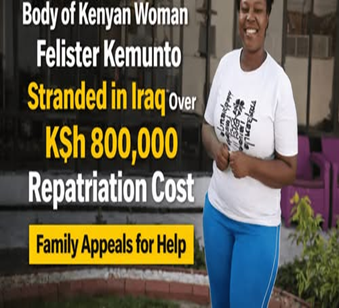
The tragic case of Ms. Felister Kemunto, a 32‑year‑old Kenyan domestic worker who died in Iraq in December 2025 and whose body remains stranded in Baghdad due to the family’s inability to raise the KSh 800,000 required for repatriation, has brought renewed attention to the urgent need for structured support systems for Kenyans living and working abroad. More than a month after her passing, her family continues to appeal for assistance while struggling to obtain clear information from the employer and recruitment agency regarding the circumstances of her death.
In recent years, there have also been multiple cases of Kenyans who tragically died within days or weeks of arriving abroad, often before they could begin working or settle into their new environments. These sudden deaths leave families in profound shock and burdened with overwhelming repatriation costs they could never have anticipated. In several instances, families have been forced to raise millions of shillings on short notice, despite having already invested heavily in travel, placement fees, and relocation expenses. These cases further underscore the urgent need for a structured national solution that protects families from financial devastation during moments of grief.
This painful pattern reflects a systemic and recurring challenge faced by the diaspora whenever tragedy occurs. Repatriation has become the single most pressing burden for the diaspora across the world. In countries such as Canada and the United States, the combined cost of repatriation and funeral arrangements can exceed KSh 2.5 million, placing an unbearable financial strain on grieving families.
Over the last two years alone, more than 400,000 Kenyans have migrated abroad for work, joining millions of others already living and working across the world. This unprecedented outflow underscores the scale of Kenya’s global workforce and the urgent need for structured protection mechanisms. At the same time, annual diaspora remittances have almost doubled compared to 2024, surpassing KSh 1.1 trillion by December 2025 – a contribution so significant it could fund all 47 counties three times over. These remittances now exceed earnings from many traditional exports and remain one of the most stable sources of foreign exchange for the country. Despite this immense contribution, the systems meant to protect the diaspora remain fragmented or nonexistent.
The Government of Kenya needs to take urgent and decisive action by establishing a Diaspora Welfare Insurance Fund to ensure that no Kenyan family is ever again left to shoulder the financial burden of repatriation. Such a fund should provide affordable, flexible premium options, automatic coverage for repatriation in the event of death, transparent management through a government–private sector partnership, and optional add‑ons such as medical evacuation and emergency assistance.
It is recommended that participation in the Diaspora Welfare Insurance Fund be made mandatory for all Kenyans travelling abroad under formal labour migration agreements, ensuring that every worker deployed through government‑approved channels has guaranteed repatriation coverage from the moment they depart Kenya. This measure would protect families from sudden financial hardship and strengthen Kenya’s labour mobility frameworks.
The Government also needs to create a centralized diaspora registration system to enable accurate identification and verification of diaspora members, efficient enrollment into insurance and welfare programs, faster emergency response, and stronger consular accountability. A streamlined registration framework will ensure that all Kenyans abroad are visible, supported, and able to access essential services when needed.
Diaspora representation in the Bicameral Parliament remains essential. A dedicated voice in both the National Assembly and Senate would ensure that diaspora concerns such as labor protections, repatriation, remittances, and migrant welfare are addressed through legislation rather than ad‑hoc interventions.
The case of Felister Kemunto is a solemn reminder of the urgent need to strengthen Kenya’s support systems for its global citizens. As a nation that now receives over KSh 1.1 trillion annually in diaspora remittances and continues to witness rapid growth in its overseas workforce, Kenya must ensure that the welfare of the diaspora is treated as a national priority.
Dignity in life must be matched by dignity in death. By working together, the Government, SDDA, and diaspora leadership can embrace dialogue that will culminate to a sustainable, compassionate, and effective system that ensures no Kenyan in the diaspora is ever left to struggle alone.
End:
Ephraim Mwaura
Chairman
Diaspora Bicameral Parliamentary Framework Caucus
President and Executive Director
Kenyan Canadian Association
Email: ephraim@kcacanada.org